GMSL2 serializer/deserializer support with multi-camera acquisition and link diagnostics
Enabling long-reach dual-camera MIPI CSI-2 pipelines over coaxial cable with on-target Eye Mapping and Link Margin diagnostics on PHYTEC’s phyBOARD-Pollux.

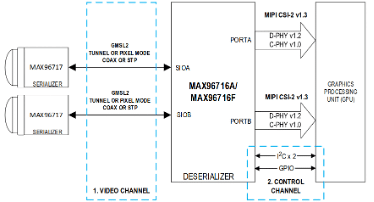
GMSL2 SerDes architecture. Diagram supplied by Norik.
Client
PHYTEC, an embedded hardware and SoM vendor for industrial and IoT products. Technical partnership and BSP / driver development on phyBOARD-Pollux with NXP i.MX8M Plus.
Problem
Camera modules in industrial and robotics applications are often mounted far from the host SoC, behind panels, on moving arms, or distributed across a system, where direct MIPI CSI-2 connections are intended for short cable runs. Bridging that gap without sacrificing image quality or signal integrity requires a serializer/deserializer (SerDes) solution. The Linux kernel driver ecosystem for GMSL2 SerDes pipelines is fragmented, with upstream support incomplete and vendor drivers requiring significant adaptation to work correctly with specific camera sensors and SoC platforms.
Solution
Norik developed a complete GMSL2 camera pipeline for PHYTEC's phyBOARD-Pollux, enabling camera modules to be placed several metres from the SoC over a single coaxial cable. The work centred on the Analog Devices MAX96716F deserializer and MAX96717F serializer pair, carrying MIPI CSI-2 traffic over GMSL2 links.
Drivers for both SerDes chips were not yet available in the upstream Linux kernel. Norik backported and integrated the latest driver versions from the kernel mailing list, then extended them with several features required for production use: simultaneous dual-camera acquisition (Sony IMX462 and ON Semiconductor AR0144) over a single deserializer with independent media pipeline configuration per port; on-chip ADC and temperature readout from the serializer for auxiliary sensing and thermal diagnostics; and configurable Forward Error Correction (FEC) with live status readback and a dedicated link health monitoring tool. Targeted fixes were also contributed to the AR0144 and IMX462 sensor drivers for correct operation in the GMSL2 pipeline context.
Norik also implemented GMSL2 link diagnostics tools directly on the target, including an Eye Mapping Algorithm for visualising signal eye diagrams and a Link Margin Algorithm for quantifying the available noise margin on each GMSL2 link. These tools allow link quality to be assessed and tuned without external lab equipment.
The solution was delivered as an integrated Yocto layer including device tree overlays, udev rules for stable device naming, pipeline configuration scripts and user-facing documentation.
Technologies used
Need a similar camera or SerDes enablement?
If you are integrating GMSL2 links, multi-camera pipelines onto i.MX, or need custom kernel drivers inside a Yocto BSP — we can help.