Enabling intelligent camera sensing and multi-channel audio on a custom healthcare embedded platform
End-to-end bring-up of a Sony IMX462 ISP camera pipeline with automatic day/night switching and a 4-microphone PipeWire & Sound Open Firmware audio subsystem on NXP i.MX8MP.
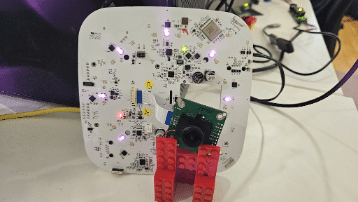
VanBreda custom hardware and camera during bring-up. Photo supplied by Norik.
Client
VanBreda, a Dutch company developing smart healthcare solutions for elderly care, disability care, and mental health services. Their products support the healthcare sector in delivering warm, high-quality and safe care.
Problem
VanBreda had a custom i.MX8MP-based baseboard featuring a Sony IMX462 image sensor and a multi-microphone audio subsystem (4 PDM microphones and a TAS2563 mono speaker). The camera required a full driver and ISP integration path to deliver usable video output. The audio subsystem suffered from instability and reference clock conflicts between simultaneous capture and playback. The client also wanted to explore the i.MX8MP DSP capabilities via Sound Open Firmware as a foundation for future noise cancellation workloads.
Solution
Norik engineers delivered end-to-end bring-up of both subsystems and integrated all work into a reproducible Yocto layer (meta-vanbreda).
For the camera pipeline, the Sony IMX462 was enabled using the imx290 kernel driver with extended mode support. MIPI CSI-2 timing parameters were tuned iteratively on the custom hardware to eliminate missing-line artifacts. The NXP ISI and ISP (vvcam) pipelines were both commissioned, supporting 10-bit and 12-bit RAW Bayer output at 1920x1080 and 1280x720 resolutions up to 60 FPS. ISP configuration files and colour-correction parameters were developed for each mode, along with RTSP and UDP streaming setup scripts. A camera mode-selection algorithm was also developed, using YUV statistics, ISP gain, exposure, and blue-channel ratio to automatically switch between colour and night-vision modes based on IR-filter state.
For the audio subsystem, the TAS2563 speaker and four PDM microphones were stabilised by addressing a codec errata and updating the driver to the tas2781 code base. Simultaneous capture and playback was validated via a shared reference clock path. PipeWire was integrated as the system audio layer and VoIP was validated with pjsua and Linphone. Basic DSP audio support was also explored using Sound Open Firmware, with a custom topology developed for 4-channel PDM capture and TAS2563 playback.
Technologies used
Bringing up custom camera or audio hardware on i.MX8MP?
Whether you need ISP tuning, multi-microphone PipeWire and Sound Open Firmware integration, or a production Yocto layer — we can help.